
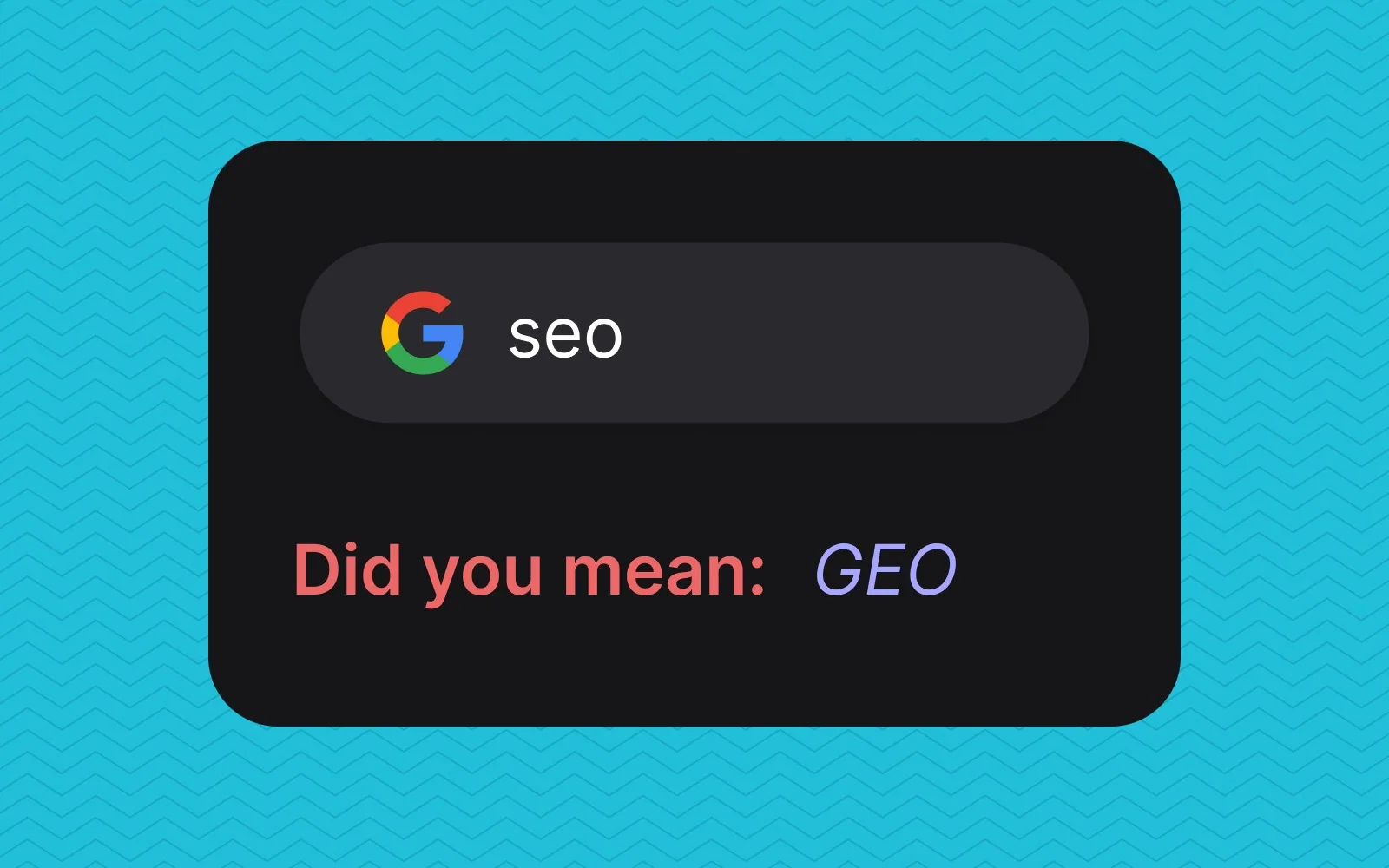
Many marketers see Generative Engine Optimization (GEO) as a new coat of paint on Search Engine Optimization (SEO), but this view misses a fundamental transformation in customer discovery. The rise of AI answer engines has changed the core mechanics of how people find information. This new discipline—also referred to as Answer Engine Optimization (AEO)—is not about climbing a ranked list of links; it’s about becoming a trusted source embedded within a direct, synthesized AI answer. That shift requires an entirely new playbook.
The paradigm has moved from navigation to conversation. For two decades, the goal was to earn a top spot on a page of blue links to win a click. Discovery now increasingly begins and ends inside an AI interface. Users ask a question and receive a single, consolidated answer. Your brand’s success no longer depends on whether you are listed, but on whether your facts, framing, and evidence are selected to form the basis of that answer. This article is a reality check—and a reset of the mental model required to win in an AI-first world.
SEO Optimizes Ranking. GEO Optimizes Being Chosen.
The difference isn’t philosophical, it’s mechanical. Different engines select information differently, so the inputs that win are different.
It’s true that SEO was primarily about driving clicks while GEO is about informing the answer—but stopping there understates how different the underlying systems are. GEO is not “SEO with new outputs.” It is optimization for a fundamentally different selection mechanism.
SEO is ranking-based; GEO is selection-based, —your content has to be chosen, not just found.
In classic search, you can “win” by ranking well even if users never deeply evaluate your page. In generative engines, you only win if the model selects your content as supporting material inside a synthesized answer.SEO is page-level. GEO is passage-level.
Generative engines do not consume pages the way humans read them. They extract specific chunks—definitions, steps, comparisons, statistics, short explanations—and recombine them. That shifts optimization toward canonical answer blocks and citable micro-sections, not just long-form narrative.SEO rewards relevance and links. GEO rewards evidence and attribution.
Foundational GEO research from Princeton, Georgia Tech, and the Allen Institute for AI demonstrates that visibility gains come from making content more verifiable and extractable, not simply more keyword-aligned. The researchers report that GEO strategies can increase inclusion in generative responses by up to ~40%.SEO results are lists. GEO results are narratives.
In a narrative answer, you are competing for framing—who is described as the default, the trusted, the recommended, and sometimes whether you are mentioned at all.
Why This Shift Is Accelerating (And Why GEO Is Now Urgent)
This shift is not theoretical. The largest platforms are actively collapsing “search” into AI-first experiences.
Google is now testing flows where AI Overviews can push users directly into AI Mode, allowing people to move from a summary into follow-up questions without returning to the traditional “ten blue links” interface. At the same time, forecasts suggest the same direction of travel. Gartner predicts that by 2026, traditional search engine volume will decline by 25% as search marketing loses share to AI chatbots and virtual agents.
AI Overviews are already changing the economics of visibility: an Ahrefs analysis found that when an AI Overview appears, click-through rates for top-ranking pages are ~35% lower, reinforcing why GEO is about being included in the answer, not just ranking beneath it.
Discovery is no longer about finding information. It’s about being included in the answer that shapes a decision.
SEO vs. GEO: A Clear Comparison
SEO and GEO share the same origin, helping people discover information, but they optimize for different engines, different user behavior, and different outcomes.
Feature | SEO (Search Engine Optimization) | GEO (Generative Engine Optimization) |
Primary Target | Google, Bing | ChatGPT, Gemini, Perplexity, Claude |
End Goal | Clicks and traffic | Citations and authority |
User Interaction | Keyword-based queries | Conversational prompts |
Preferred Format | Pages, metadata, links | Factual snippets, quotes, statistics |
Success Metric | Rank & CTR | Mentions, citations, sentiment |
Bottom line: the optimization target changed. When answers replace links, you don’t win by ranking—you win by being selected as source material. That shift is what changes the tactical playbook.
From Ranking Signals to Selection Signals: What You Change in Practice
Once you accept that GEO is selection-based and passage-driven, the tactics change. The goal isn’t to “do SEO harder”, it’s to ship content that is extractable, verifiable, and reusable inside an answer.
Classic SEO tactic | Why it’s not enough for GEO | GEO-aligned approach |
Keyword targeting + expansion | Models can read whole pages, but they reuse specific claims | Write answer blocks with explicit, liftable statements |
“Longer content ranks” | Length helps only if the key points are easy to extract | Use clear sections/ TLDRs/ FAQs so the best claims stand out |
Backlinks as the main signal | Backlinks still matter, but answers favor verifiable proof | Pair authority signals with citable stats + sources |
Rank tracking | Rank doesn’t show how you’re mentioned/cited in answers | Track visibility + citation share + sentiment |
The pattern is consistent: as the system shifts from ranking pages to selecting passages, the work moves from optimizing signals for search engines to structuring information so it can be confidently reused by AI models.
What “Citation-Engineered” Content Actually Means
In practice, citation-engineered content looks different from traditional SEO copy—not because it is shorter, but because it is structured for selection. GEO-ready content puts the answer first, then immediately supports it with verifiable evidence: clear definitions, concrete numbers, responsible citations, and—when appropriate—quotable expert statements. This structure reduces uncertainty for the model. The claim is explicit, the proof is nearby, and the logic is easy to reuse.
The Princeton GEO research reinforces this approach, showing that evidence-oriented edits—such as adding citations and statistics—materially improve the likelihood that content is incorporated into generative responses. The mental shift is straightforward: write less like you are trying to earn a click, and more like you are publishing a canonical truth the model can safely repeat.
Benchmarking + Building: The Feedback Loop for AI Visibility
Once the win condition becomes inclusion and citation, measurement has to reflect that reality. Traditional SEO metrics like rankings and organic traffic are inadequate for measuring influence in an AI-answer ecosystem. To manage performance, brands need GEO-specific KPIs that measure whether they are showing up in answers, not just earning clicks:
Visibility Score: How often and how prominently your brand appears across relevant prompts
Share of Voice: Your visibility in AI answers compared to competitors
Citation Share: How frequently models cite your content
Sentiment Score: How your brand is framed inside answers
Consistent, automated tracking across major LLMs is non-negotiable. Manual spot-checking does not scale. This is fundamentally different from traditional brand monitoring tools like Meltwater or Talkwalker, which track social and media mentions rather than AI answer inclusion.
Once visibility is measurable, it becomes engineerable. GEO content strategy shifts from keyword-led publishing to building a library of authoritative answer blocks designed for AI ingestion: high factual density, structured data, and citable claims governed by a consistent brand narrative.
Yolando: Executing the GEO Playbook
Understanding GEO is only the first step. Execution is the real challenge: running prompt baselines across models, auditing outputs, identifying citation and factual gaps, and shipping improvements consistently—without losing brand governance.
Yolando is built for that execution loop:
AI Visibility tracks brand presence, sentiment, and competitive placement across major LLMs using GEO-native metrics.
Marketing Studio (Recommendations → Execution) translates visibility gaps into publish-ready fixes—where to add canonical answers, which claims need sourcing, what FAQs or comparisons are missing.
Knowledge Base centralizes canonical brand truths so AI systems receive consistent, trustworthy signals.
The goal isn’t to publish more content. It’s to publish content that AI systems can accurately cite.
Embrace the Shift, or Let AI Define You
GEO is not a rebrand of SEO. It is a response to a new discovery system where answers—not links, shape decisions. Brands that cling to ranking alone are already ceding narrative control.
The opportunity is clear: brands that are easy to cite become hard to ignore. It’s time to embrace the AI-first model and use purpose-built platforms like Yolando to achieve clarity, control, and momentum in AI-powered discovery.
Ready to win AI responses? Book a demo with Yolando.