Company Updates
Intern Spotlight: Fabian Bayona – From Curious Newcomer to Agent Orchestration Specialist


Some internships hand you a checklist. Others hand you a front-row seat to the hardest problems the team is working on, and extend you trust on day 1 for you to help solve them.
Fabian Bayona's four months at Yolando have been the latter.
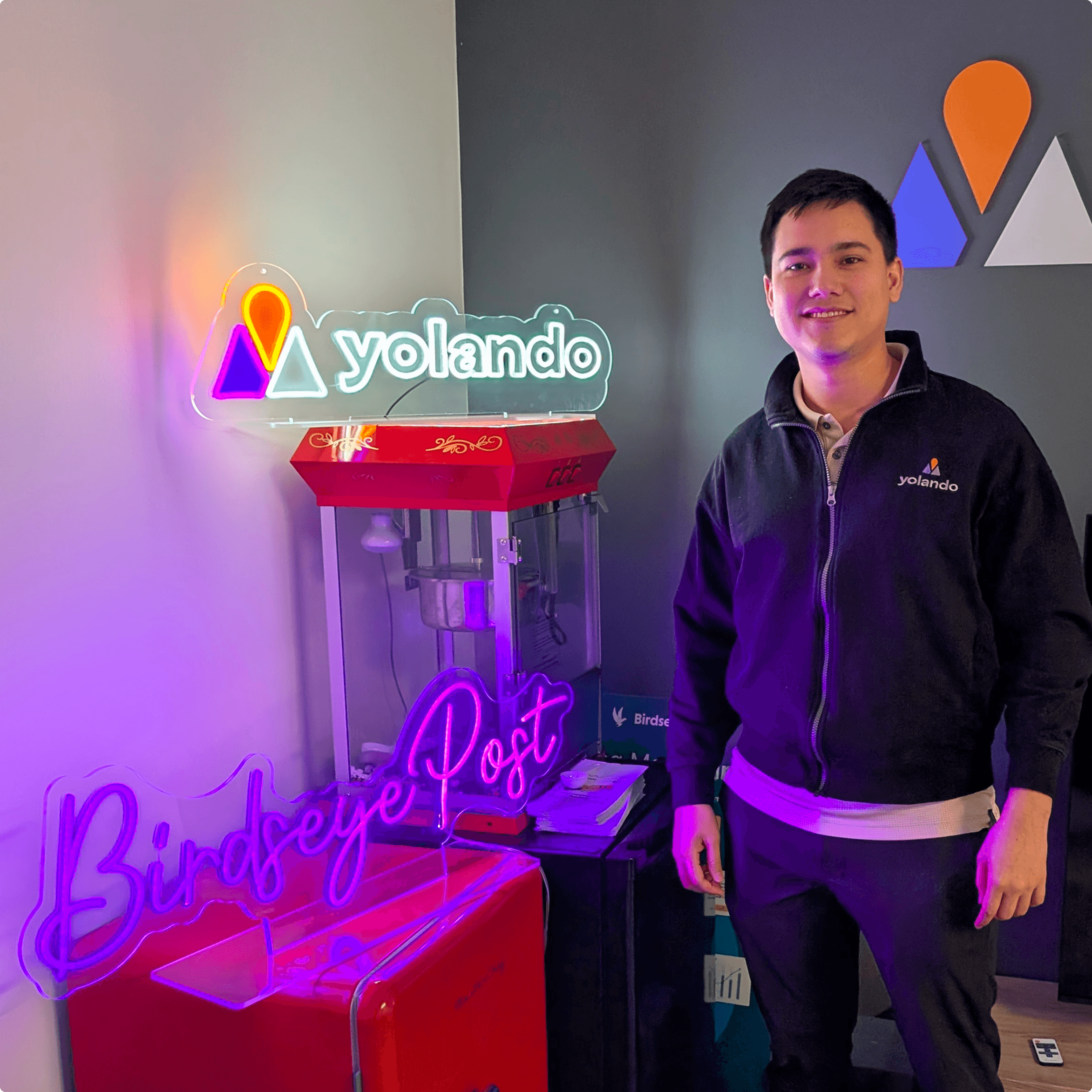
As a Management Engineering student heading into his final year of university, Fabian joined Yolando as a University of Waterloo Co-op intern expecting to get some hands-on, real world, practical experience. What he got was a deep dive into agent orchestration, hands-on time with the evaluation framework powering Yolando's AI systems, and a team culture that surprised him so much he compared it to Charlie and the Chocolate Factory—the "golden ticket" he didn't know he was signing up for.
This is what his four-month experience looked like:
More Than Any Classroom: Real-World Engineering at Pace
When Fabian reflects on his co-op, his first comparison isn't to another internship—it's to his university coursework.
"I've been telling everyone since probably the first month that here I'm learning more than I've ever learned in any course at the university. The real-life experience is way different than any course, because here you actually use what you need for the industry."
Classroom fundamentals matter. But applying them to production systems, with real users on the other end is a different kind of learning. Fabian was surrounded by engineers who cared about their craft, and he found himself absorbing not just how to code properly, but what it feels like to work alongside people who love what they do.
"I gained a deeper understanding of what it means to be on a team that actually enjoys what they're doing. Being surrounded by that kind of energy leads you to work better, to work harder. It's not like other places where it's five o'clock and people are already running home."
Inside the Agent Harness: Deep AI Work
Ask Fabian about his favorite project and he doesn't hesitate: the agent harness and the evaluation framework.
"It really gave me an understanding of how the agents work behind the scenes. It's not just how to create agents, but how we can improve them. Pushing them to think better, perform faster, and while being efficient with Claude token use."
For Fabian, this wasn't just another task. It was a chance to understand one of the most important layers of modern software. The AI systems that power nearly every product being built today!
"Nowadays almost every software uses AI, so understanding how they work properly is a way to have a much better understanding of how many apps work. That's pretty interesting, especially in these times."
Ramping Up on a Big Codebase
Fabian was honest about where the work stretched him most at the beginning.
"The biggest challenge was the first week, trying to get used to the pace of Yolando and trying to understand the full codebase, because it's big. There's a lot going on."
The challenge didn't last long, not because the problem got easier, but because the team made it easier for him to tackle.
"Any question I had, they would sit with me for an hour, for 30 minutes, without any problem, and just explain what was going on. Thankfully, because everybody was so supportive, I quickly adapted to the company and the codebase."
A Team That Chases What's New
When asked what surprised him most about Yolando, Fabian's answer came quickly: the team's appetite for innovation.
"How willing the team is to innovate, and how good they are at adapting to emerging AI technologies. Every time there's something new going on, everybody talks about it. Everybody tries to understands the best way we implement this at Yolando?"
He pointed to Kevin as an example, helping him dig into MCP and Claude Code's source map to look for ways to improve our agent harness.
"In some places, people don't really care. They're given a task, they do it, and that's it. Here, they really go beyond and try to do things better."
That culture rubbed off. By the end of his term, Fabian wasn't just tracking new models and tools because he had to, he was doing it because he wanted to.
"After hearing everybody talk about the new model by Anthropic, or some new open source thing, that made me more intrigued to research it myself, get into forums where they talk about these new trends, and try to implement it in my own projects and personal projects as well."
Orchestrating Agents: The Skill That Stuck
The technical takeaway Fabian keeps coming back to is agent orchestration. He designed workflows that enabled agents to communicate with each other, talk to customers, and produce efficient outcomes.
"The biggest skill I gained here was really how to orchestrate agents, how to make them work efficiently, create workflows so they can talk to each other and to customers through AI chatbots. And also how they work under the scenes, as I mentioned with the agent harness."
That skill is exactly where he wants to head next.
The Moment It Clicked: Hearing About Sales
When asked when he first felt like part of the team, Fabian pointed to one specific moment each week when Yolando's co-founder and CEO Matt shared weekly updates on sales and prospective customer conversations.
"When Matt talks about sales and how the product is performing, that really makes me feel like I'm doing something for somebody. Not just behind the computer writing some code, but actually part of a team that's helping people. I'm helping companies get better SEO and GEO visibility. Matt especially made me feel very much part of his team."
That's the kind of connection that turns a job into a mission, seeing how the code you write translates into revenue, into happy customers, into a product that's working in the market.
A Family Vibe That's Hard to Replicate
Ask Fabian what he'll miss most, and he doesn't point to a project or a tool. He points to the people.
"What I'll miss the most is definitely everyone here. The work environment, the vibes. I never felt any kind of bad tensions. It was kind of a family. Everybody's a friend of everyone. Going to coffee shops to talk about the latest trends, what else to add to the product."
He contrasted it with his previous co-ops, where coworkers barely knew each other's names.
"Here, everybody is really a friend of each other. That's something that will probably take me awhile to find somewhere else."
What's Next
Fabian's heading back to university to finish his final year. After graduation, he wants to keep building in the space he discovered at Yolando.
"I could change my career path toward more agentic stuff, probably working on workflows or agent orchestration. Helping companies get their ideas into reality, save them time, optimize their workloads, or create internal or external agents like Yolando."
The Golden Ticket
We asked Fabian to sum up his time at Yolando with a movie title. After a few options, he landed on the one that stuck:
"Charlie and the Chocolate Factory. I wasn't expecting much, and I ended up with something amazing — like a golden ticket. It gave me one of the best four months of my life, where I learned the most. Even though I'm leaving the company, this experience is more valuable than even the golden ticket."
Thanks, Fabian
Fabian shipped real work on some of Yolando's most technically demanding systems. He leveled up in agent orchestration, absorbed a team culture of curiosity, and left the codebase (and the team) better than he found it.
We couldn't have asked for more from a co-op. We'll miss him. And we can't wait to see what he builds next.
Interested in joining the team? If you're looking for a co-op where you'll own real engineering work, collaborate with people who care deeply about what they're building, and ship production AI systems, reach out at info@yolando.com.