Company Updates
Intern Spotlight: Kevin Cheng (Part Two) – From Full-Stack Owner to End-to-End Shipper
April 24, 2026


Eight months ago, Kevin Cheng walked into Yolando on his first day expecting to work on one product — and was promptly pivoted onto a brand-new one called Yolando. We wrote about his first four months back in December: how he went from a backend beginner to a full-stack owner, shipping his first features into production alongside senior engineers.
Today, Kevin's co-op is wrapping up. And the Kevin finishing his second term isn't the same Kevin who started his first.
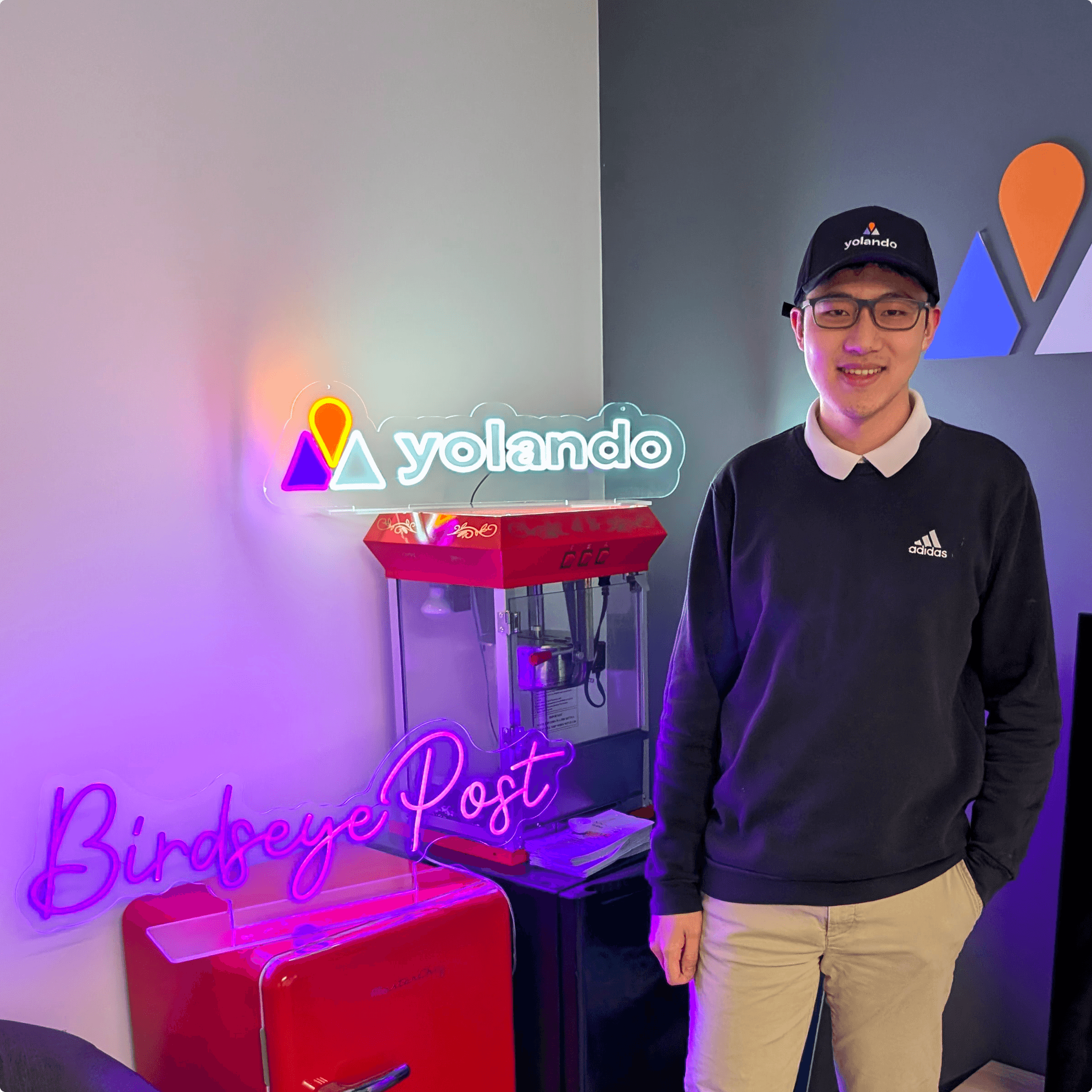
Over the past four months, he's owned Yolando's self-serve billing flow end-to-end, shipped full features from design doc to deploy, and watched the product evolve from an early-stage idea into a real, usable platform that customers can onboard themselves into. Where the first half of his co-op was about ramping up, the second half was about shipping at full speed.
Here's what closing out eight months at Yolando looked like:
From Idea to Fully-Fledged Product
Ask Kevin to describe the arc of his eight months, and he doesn't talk about individual tasks. He talks about watching a product come to life.
"Being here eight months at Yolando, I've really seen it grow from basically pretty much an idea all the way to a fully-fledged product. I describe it as a high-growth and very high-ownership co-op experience."
That ownership showed up at every layer of the stack.
"I got to learn the product through how the idea came to be, then working on the initial designs, just having something to show our users — and then eventually building out the fully fleshed-out product from the back end all the way to all those small details on the front end."
For a co-op, that's a rare trajectory. Most interns show up to a mature codebase and touch one slice of it. Kevin got to help shape the whole thing.
The Billing Project: A Full-Stack Build from Scratch
When Kevin talks about his favorite project from this term, one stands out: the self-serve billing flow.
"We wanted to introduce a way for our users to self-serve on our product. I redesigned the full onboarding flow to include the billing process using Stripe integration, and then allowing skip payment for our employees so that when we have customers we're walking through the onboarding process, we're still able to quickly set up accounts and get them onboarded."
This wasn't a small feature. It stretched from design document to Stripe configuration to the back-end and front-end logic that had to cleanly process payments and move users through the flow.
"A lot of learning there — from the design document all the way up to setting everything up on Stripe, and then working the back end and front end together to control the logic and process those payments, and smoothly move the user through the billing process."
A self-serve billing flow is one of the most important things any SaaS product has. Kevin built ours.
The Biggest Surprise: How Fast Yolando Ships
At his previous co-ops, Kevin got used to a slower rhythm — multiple teams, multiple approvals, waiting days or weeks for simple changes to land. At Yolando, that pattern flipped completely.
"At my previous co-ops, things always moved much slower. It was really waiting for a lot of approvals. Anything would take at least three different teams to get done. I remember trying to write a migration for a very simple change — I was just adding an extra field — and I had to talk to a database optimization team, then the team that did the data migration, then also work with my own team to make sure this was actually what we wanted, just so we wouldn't have to go back and talk to those other two teams."
At Yolando, the loop is tight enough that a migration can go from idea to production in hours.
"Here, I was able to write my migration, test it, make a pull request, and someone on the back-end team would approve it or leave a comment. I was able to just get that deployed — it would literally be out the next release."
That speed is only possible because the team trusts each other to ship quality work. Kevin earned that trust, and then got to move at the pace it unlocked.
The Hardest Part: Building Before the Thing Was Built
Kevin was honest about what was hard, especially early on.
"When I started, the Yolando project was still in very early stages. Understanding what we were building was a little abstract at the start. We wanted to show a dashboard, visibility, content generation, and how that would all work together to create a product — but at the start, there wasn't really anything to build off of. It was kind of a new sprouting seed."
Building a product before it fully exists is a different kind of problem than extending an existing one. Kevin handled it the way the team handles most things: by collaborating closely with whoever was closest to the problem.
"Working on the front end, it was a lot of talking with Kevin and with Corey to go through designs and figure out what the best way to show all this data was."
There was also the challenge of navigating legacy code that had been ported over from older projects during the early push to build fast.
"We had ported over a lot of old repositories from BirdseyePost. There was a lot of code that wasn't used for Yolando, but because we were copying over repositories, some of it was in places that weren't being used. It was a little difficult parsing through all of the code to understand what was actually being used versus what was legacy code that needed to be removed."
The Skill He's Taking With Him: Shipping End-to-End
Kevin's previous co-ops gave him pieces of the puzzle — a checkout component here, a disclaimer banner there. Yolando gave him the whole thing.
"Technical-wise, the biggest skill I've learned is shipping an end-to-end product. I never really got to do that in my previous co-ops. It was very small features — like, we were going to design this checkout component, so you'd work on some of the fields, or there's this disclaimer we need to add at the bottom and the logic for when to show it. Small components."
"Here, I was able to ship full features. The learning process of going from a design document and ideas and researching what the best way to do that is, then actually implementing the feature, and getting feedback on how resilient or how easy to understand it was — that was a very good learning experience for me. I was able to really understand how we can build a whole feature from start to finish with the best design and software engineering practices."
That's the skill every engineer eventually needs and few co-ops actually teach. Kevin leaves Yolando with it.
The Team He'll Miss
Ask Kevin what he'll miss most, and he doesn't hesitate. It's the people.
"Kevin has been a great help to me — he's the front-end engineer. He's really taught me a lot. We've discussed a lot about the features we were building and how to approach such a fast-moving project. At the start, when designs were constantly changing and the back end was already complete and we wanted to ship the feature out, Kevin and I would discuss ways to mock up a design that looked usable, something the user would enjoy using, that let us work fast."
He was just as generous with the rest of the team.
"On the back end, Sarth and Shardul have been a great help — helping me understand Pydantic ORM models, since I hadn't actually worked with the libraries we use. I used to use Java at my previous co-ops, and a little bit of Python, but not to the extent here. Learning a lot about how migrations worked here, how we do a lot of the AI model stuff, how the back-end logic works — it was wonderful."
And on the product side:
"Corey, you've been an amazing project manager. You helped me a lot to prioritize tasks and gave me good feedback on design. It's been wonderful working with you and Kulin."
This is the kind of team that makes interns want to extend their co-ops. Kevin already did that once. Closing out the full eight months, it's clear why.
Fast But Extremely Fruitful
We asked Kevin to sum up his full Yolando experience in one sentence. His answer was immediate:
"Fast but extremely fruitful. We learned a lot. I was able to work with the team and really enjoyed the connections I made here."
That's the whole co-op in six words.
Thanks, Kevin
Kevin joined Yolando when it was still an idea. He leaves with the product shipped, a self-serve billing flow running in production, and a full-stack skill set that most engineers don't have at this stage of their career.
It's hard to imagine Yolando without him — he's been here since the start. We'll miss him. And we can't wait to see what he builds next.
Interested in joining the team? If you're looking for a co-op where you'll own real features, ship end-to-end to production, and work alongside people who move fast together, reach out at info@yolando.com.
The Full Interview
Below is Kevin's full exit interview with Corey Tinianov, lightly cleaned up for clarity.
Corey: Overall, how would you describe your work term at Yolando — this being your second co-op in a row?
Kevin: Being here eight months at Yolando, I've really seen it grow from basically an idea all the way to a fully-fledged product. I'd describe it as a high-growth and very high-ownership co-op experience. I got to learn the product through how the idea came to be, working on the initial designs, just having something to show our users — and then eventually building out the fully fleshed-out product, from the back end all the way to all those small details on the front end.
Corey: What's your favorite or most interesting project from this term — the one you're most proud of?
Kevin: I got to work on the billing project. We wanted to introduce a way for our users to self-serve on our product. I redesigned the full onboarding flow to include the billing process using Stripe integration, and then allowed skip payment for our employees — so that when we have customers we're walking through the onboarding process, we can still quickly set up accounts and get them onboarded.
There was a lot of learning there — from the design document all the way up to setting everything up on Stripe, and then working the back end and the front end together to control the logic, process those payments, and smoothly move the user through the billing process.
Corey: What advice would you give someone who's about to join Yolando?
Kevin: Yolando is a fast-paced environment, and because our product is quite new as an industry, really getting to know what we're trying to build here is important. It's different from what other products are generally doing in the AI space. We're really trying to use AI to do marketing for a bunch of companies and get their AI visibility as high as possible. Understanding how that works and how we're doing it is pretty important to having a successful term here.
The product is new and the space is always growing, so new ideas are always welcome to be thrown around and developed on here.
Corey: What would you say was the largest challenge you overcame personally here?
Kevin: When I started, the Yolando project was still in very early stages. Understanding what we were building was a little abstract at the start — we wanted to show a dashboard, visibility, content generation, and how that would all work together to create a product. But at the start, there wasn't really anything to build off of. It was kind of a new sprouting seed. Everything was new, and we were trying to figure out what to use and how to display all these things. Working on the front end, it was a lot of talking with Kevin and with you, Corey, to go through designs and figure out the best way to show all this data.
Also on the back end — it was interesting, because we were trying to build fast, so we had ported over a lot of old repositories from BirdseyePost. There was a lot of code that wasn't used for Yolando, but because we were copying over repositories, some of it was in places that weren't being used. It was a little difficult parsing through all of the code to understand what was actually being used versus what was legacy code that needed to be removed. With AI now, it's much easier to go through all of that.
Corey: What would you say surprised you the most — even looking back since you started your first term?
Kevin: How much the team has been able to do here. At my previous co-ops, things always moved much slower. It was really waiting for a lot of approvals. Anything would take at least three different teams to get done. I remember trying to write a migration for a very simple change — I was just adding an extra field — and I had to talk to a database optimization team, then the actual team that did the data migration, then also just work with my own team to make sure this was what we actually wanted, just so we wouldn't have to go back and talk to those other two teams about needing another field. It would just take forever to get anything done on the back end.
Here, things moved a lot faster. I was able to write my migration, test it, make a pull request for it, and someone on the back-end team would approve it or leave a comment. I was able to just get that deployed — it would literally be out the next release.
Corey: Is there one skill you feel you gained since you started working here — either technical or personal?
Kevin: Technical-wise, the biggest skill I've learned is shipping an end-to-end product. I never really got to do that in my previous co-ops. It was very small features — like, we were going to design this checkout component, so you'd work on some of the fields, or there's this disclaimer we need to add at the bottom and the logic for when to show it (it was only based in the US, so you'd show one disclaimer; if it were in Canada, you'd show a different one). Small components.
Here, I was able to ship full features. The learning process of going from a design document and ideas — researching what the best way to do that is — and then actually implementing the feature, and getting feedback on how resilient or how easy to understand it was, that was a very good learning experience for me. I was able to really understand how we can build a whole feature from start to finish with the best design practices and the best software engineering practices.
Corey: What are you going to miss the most after eight months here?
Kevin: The team. Kevin has been a great help to me — he's the front-end engineer. He's really taught me a lot. We've discussed a lot about the features we were building and how to approach such a fast-moving project. At the start, when designs were constantly changing and the back end was already complete and we wanted to ship the feature out, Kevin and I would discuss ways to mock up a design that looked usable — something the user would enjoy using — and that let us work fast.
On the back end, Sarth and Shardul have been a great help — letting me understand Pydantic ORM models, since I hadn't actually worked with the libraries we use here. I used to use Java at my previous co-ops, and a little Python, but not to the extent here. I learned a lot about how the migrations work, how we do a lot of the AI model stuff, and the back-end logic.
And of course, Corey — you've been an amazing project manager. You've helped me a lot to prioritize tasks and given me good feedback on design. It's been wonderful working with you and Kulin.
Corey: If you were to give your full experience here a title, as if it was a movie, what would you call it?
Kevin: That's a hard one. Maybe something along the lines of Startup — or, if I were just to explain the experience in one sentence, that might be easier.
Corey: That works too.
Kevin: In one sentence, I'd say the experience has been fast but extremely fruitful. We learned a lot. I was able to work with the team and really enjoyed the connections I made here.
Corey: That's great. Thank you — we're going to miss you. It feels like you've been here since the start of Yolando, so it's hard to imagine Yolando without you.
Kevin: Thank you. I really appreciate it.